Lukas and Matthias’s Father-Son Relationship
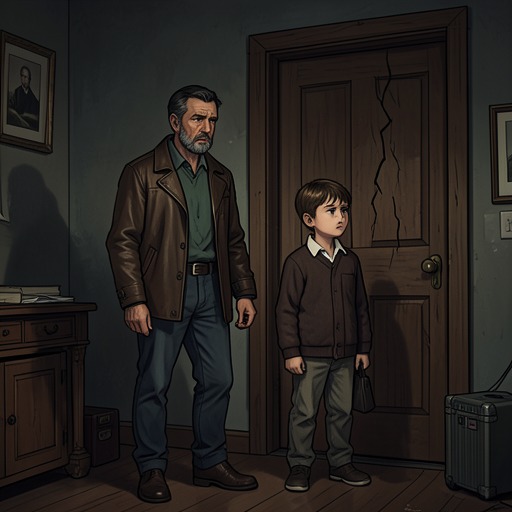
Sonne und BetonLukas and Matthias’s Father-Son Relationship is a bond of concern continually strained by disagreement over what life around them demands. Matthias wants Lukas to avoid violence, yet Lukas sees that advice as detached from the danger he faces; when Matthias dismisses his account of school and neighborhood violence, concern gives way to anger and separation. Their exchanges show affection and ordinary domestic ease persisting alongside a widening failure to hear one another.
Background and Everyday Intimacy
Lukas’s response to being beaten reveals how much he expects Matthias not to understand. After an assault leaves his nose bleeding, Lukas fears his father will see his face and blame him for getting into a fight. He thinks Matthias does not grasp that being attacked is not necessarily his fault, and contrasts his father’s experience of growing up in the area with the changes Lukas believes have taken place since then. The difference is not abstract: to Lukas, Matthias’s familiar maxim that the wiser person gives way cannot account for a situation in which backing down may not prevent violence.
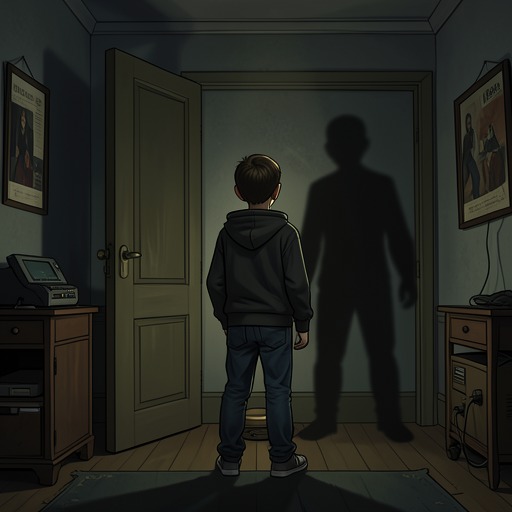
The relationship also includes unforced moments at home. On one return, Lukas hears The Doors’ Light My Fire playing loudly from the apartment and finds Matthias dancing and bustling around the living room. Lukas turns down the music; Matthias greets him and offers freshly made coffee. This cheerful domestic scene sits apart from their later confrontations. It shows a father-son routine in which Lukas can enter the shared space and address his father casually, even as the serious subjects they later raise remain unresolved.
Advice, Injury, and Conflicting Rules
After another encounter leaves Lukas with two black eyes, Matthias’s response is a mixture of exasperation and worry. He complains that the trouble has continued from Lukas’s brother Marco to Lukas, and objects that Lukas looks badly beaten just as Karin is due to visit. He asks why Lukas keeps getting involved with troublemakers. Lukas stays silent, thinking he had no real choice in the encounter and that having only bruised eyes is a relief. Their different accounts are already in place: Matthias sees a recurring pattern of avoidable trouble, while Lukas sees the limited options of someone facing aggression.
Matthias repeats the principle that the wiser person gives way and challenges Lukas to say what fighting has achieved. But his guidance is not simply a demand for passivity. In another conversation, he tells Lukas to look after himself and to fight if he has to, while warning him not to take on someone with a knife because it is not worth the risk. That qualification makes the tension more complicated: Matthias recognizes that violence may be unavoidable, but draws a line at a danger he considers beyond the value of fighting. Lukas, meanwhile, is left to decide in the moment whether retreat is possible.
Disagreement over School and Violence
The gap between their judgments becomes explicit when Lukas talks about violence at school. He points to frequent fights and the possibility of students bringing knives, and asks why his father does not respond to those dangers. Matthias appears not to believe him. He dismisses what he hears as Marco’s gangster talk and rejects the language of threats and stabbing as an influence of violent music and bravado. Lukas takes this as a familiar refusal to listen, recalling that Matthias reacted similarly when Marco had been beaten. In Lukas’s view, the same misunderstanding has already contributed to conflict between father and brother and is now being repeated with him.
The school computer theft intensifies the argument. After the police tell students that computers and monitors worth several thousand euros were stolen, and that witnesses reported three hooded men moving the goods in a shopping cart toward U-Bahnhof Zwickauer Damm, Lukas is troubled by the investigators’ account of possible gunfire nearby. When he tries to discuss the incident at home, he feels Matthias is more focused on the stolen equipment than on the violence around it. Lukas angrily insists that his reports of what happens in the neighborhood are not invented and says the computers would have been stolen sooner or later. The dispute turns on more than the theft: it exposes Lukas’s sense that his father treats the world he describes as unbelievable.
The Break at Home
Before the argument, the atmosphere in the apartment is uneasy. Lukas notices a burnt smell and feels sick; Matthias is serious rather than welcoming. On the balcony, Matthias stands beside him, breathing deeply and watching him as if waiting for him to speak. Lukas is preoccupied with messages that have not arrived from his friends, while his father takes a cigarette from the drawer but does not light it. Lukas knows Matthias had meant to quit, though he also knows he did not manage to stop. The pause and the unlit cigarette frame a conversation that neither begins easily nor stays calm.
When Matthias asks what is wrong, Lukas challenges him for treating his account of local violence as fiction. Matthias raises his voice and asks why Lukas is defending the people involved and why ordinary conversation between them has become impossible. Lukas turns the accusation around: he says his father cannot be spoken to because he lives in a sheltered version of the world and cares more about the computers than about listening to them. He takes his backpack toward the hallway, turns back, and repeats that the computers do not matter to him. Matthias slams his palm on the living-room table, knocking over two glasses, and orders Lukas out. Lukas echoes the order mockingly and leaves, describing the confrontation as the same recurring mess.
Significance
The relationship’s central conflict is not a lack of concern but a struggle over whose account of danger counts. Matthias’s warnings, questions about Lukas’s injuries, and attempts to distinguish survivable fights from lethal ones show that he wants his son safe. Yet his appeal to giving way and his dismissal of Lukas’s description of the neighborhood make that care difficult for Lukas to accept. The two speak from different experiences: Matthias interprets violence as a pattern his son should avoid, while Lukas insists that avoidance cannot always protect him. Their final quarrel turns that mismatch into physical departure, leaving the underlying disagreement unresolved.